
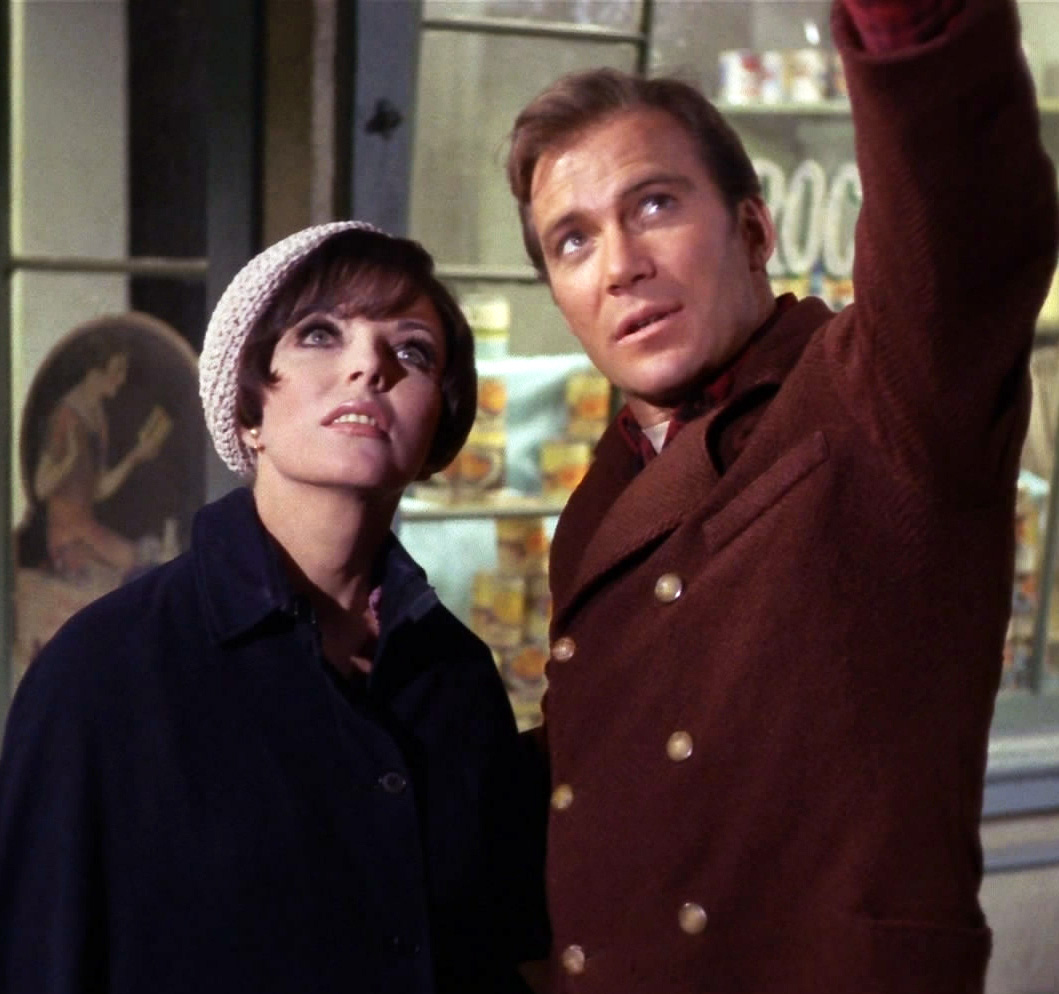
 While I was listening to Pandora on my computer the other day at work, The Scofflaws' "William Shatner" came on--a song that I'd almost completely forgotten about. If you're familiar with it, you know that it's a mega-campy tune, but all of the choice references in the lyrics make it clear that it was written by someone (Buford O'Sullivan) with more than a passing acquaintance with--and genuine affection for--the original Star Trek series from the 1960s:
He's got a fine tan shirt with an emblem on the chestAnd you gotta love how his trombone solo (from the track on the album) starts out sounding like the "red alert" alarm!
The interstellar girls all like him the best
Captain of the crew and he knows kung fu
and he did Joan Collins in 1932 [refers to "City on the Edge of Forever"]
Really just an actor, and a genius to boot
He never gets fire when the enemy shoots
So he ends each show looking neat and clean
After staring down the mouth of the Doomsday Machine [refers to "The Doomsday Machine," duh]
I really like the one where he reads the Constitution
After ending all the fighting in the future revolution [refers to "The Omega Glory"]
William Shatner!
William Shatner!
William Shatner!
William Shatner!
Scotty...we...need...more...power!
I am Kirok! [refers to "The Paradise Syndrome"]
The video clip below is from a Scofflaws' show from 1997 at Wetlands; you can catch part of "William Shatner" at around the 7:34 mark...
Several months after The Scofflaws' Ska in Hi-Fi was released in 1995, I heard a rumor that someone in the band had actually run into the Shat in an airport, told him about the song, and later sent him a copy of the CD, which he supposedly liked. I never confirmed it with anyone in the band at the time--probably because it was too good of a tale to debunk.
And many people have also noted that, in his prime, Bucket of The Toasters reminded them of Shatner (and while we are on the topic of ska musicians who look like superstars, Mike Drance of The Bluebeats looks a lot like a 70s era John Lennon).
+ + + +
 Like Buford, I have to admit that I'm a big fan of the original 1960s Star Trek series (though not a dress-up in a costume and attend conventions kind of way). My mom half-jokingly blames my dad for all this--I was a baby when Star Trek first aired and she claims that my dad would always prop me up on his lap to watch it. (It must have been surreal to watch this idealized version of the future in the late 60s, as the Vietnam War and the struggle for Civil Rights were dividing Americans and literally tearing American society apart; check out Rick Pearlstein's extraordinary Nixonland to see just how bad things were--racism and violence and injustice much worse than I have ever imagined, with Nixon at the center, manipulating Americans' hatred and fear for his own political ends).
Then, when I was a kid during the 70s, the show was in endless syndication on Channel 11 in New York, but what made it a smash sensation with all my friends when I was in third and fourth grades was when the animated version of Star Trek was shown on Saturday mornings (on CBS?). We actually played Star Trek during recess in the schoolyard (I was Scotty). I bought and built several AMT plastic model kits of the phasers, communicators, and tricorders, and remember using them as we ran around at one of my birthday parties. (The photo above is of me as Spock for Halloween, probably in 1972.)
In high school, on Saturday nights a PBS affiliate in Scranton, PA that our cable system carried would run three commercial-free Star Trek episodes back-to-back from midnight to 3:00 am. If we had nothing better to do, which was more often than not, my friends and I would hang out and watch them, trying to be the first to guess the title of the episode from the scene before the opening credits. Things were...uh...kind of slow in Yonkers.
About a year ago, I discovered that Paramount had re-mastered the original tapes of the show and replaced the primitive 1960s special effects shots of the Enterprise in space with computer-generated images (the results are pretty amazing, and make the series a lot more palatable to contemporary viewers used to state-of-the-art digital effects). So, I've been taping the episodes (on Channel 11 from 1:00 am to 2:00 am on Sundays) and watching them when I have trouble sleeping at night...
+ + + +
Speaking of internet radio, Pandora and other similar sites recently came to an agreement with SoundExchange (the nonprofit organization that collects and distributes digital royalties on behalf of artists and labels) regarding paying royalty rates for streaming songs (check out the New York Times article, as well as this piece in Ars Technica).
This is especially good news for lesser-known acts and indie labels, as they are now better positioned to earn some income from people simply listening to their music on the web (even if they're not actually intending ever to buy their CD or digital track).


0 comments:
Post a Comment